This is an opinion post and discusses violence from the outset. It does not endorse violence, nor excuse those that use it. That’s the point.
On Friday 9th October 2026, Sky News and other media outlets reported that the execution of a “death row” inmate in the U.S. would be live streamed. (This was the day before the World Day Against the Death Penalty, 10th October, by the way).
Now, moving past the ghoulish possibility of televising a real-time death for a moment (as if this is somehow a normal way to pass the time), this case and another in the spotlight, does provide the opportunity to offer an opinion on the death penalty, in the context of pacifism.
The notion of “an eye for an eye” is not new, and laws surrounding the death penalty have been around for centuries.
Despite many countries now abolishing it as a form of capital punishment, Amnesty International have reported that at least 2707 people were executed in the year 2025. They note that this is an increase by more than two thirds of those recorded in 2024.
While the existence of the death penalty in law doesn’t mean it will be enacted for every offence, at the time of writing it’s been reported that the number of executions in the U.S. has nearly doubled in the last year.
Elsewhere, the death penalty may be granted for things like drug-related offences and sexual relationships outside of marriage between consenting adults, whether of the same or opposite sex. This means, if the political will exists, this punishment could be expanded to include a husband having an affair, not just murder.
It doesn’t feel ethical, nor morally responsible, to highlight here the different methods by which an execution is carried out. Suffice it to say there are a few (and, reluctantly, some will appear in the articles linked above).
Why is this a problem?
The first question has to be: does the death penalty actually work? The short answer is no, if its purpose is deterrence.
Setting aside that, in reality, the death penalty couldn’t prevent someone from being gay, even if it stops them saying they are in public, if we were just talking about violence or drug trafficking, it’s worth pointing out that in January this year, Volker Türk, UN Commissioner for Human Rights asserted that “The death penalty is not an effective crime-control tool…”
Acknowledging just the sheer length of time it’s existed (some say as far back as the 5th century CE), we can surely agree that if the death penalty really worked as a deterrent for murder over the last 1500 years, in whatever way it was administered, there would be no new candidates for it (globally).
Crime would stop.
Violence would be a thing of the past.
Horrors would be resigned to history books.
But it hasn’t. It isn’t. They are not.
Because ending an individual who has committed murder does not address his* mindset, nor prevent others like him who wrongly think they have the right to harm. The death penalty implies that violence is ok in certain circumstances – that it’s “justified”. How does this influence the mindset of a man, for example, who thinks the same way about beating his wife?
The death penalty is unlikely to speak to a man who believes he is entitled to use violence against a woman, if the state implies there will be times when violence has a purpose.
In Deeyah Khan’s documentary Behind the Rage, Charles – one of the men who it’s understood now works to help prevent male violence – talks about how there was a time when he (wrongly) thought violence was “corrective action” and would help him “get some compliance”. This is also akin to a militarist mindset, that may imply that not only is violence necessary (as if the only answer), it is somehow “honourable”.
The death penalty also does not dilute, or even necessarily heal, the impact of the horror violent people can do. In some cases, it may even prolong or even retraumatise a victim or their family, especially where the execution attempt goes wrong. This is also how structural violence can occur in a criminal justice system.
It also has to be mentioned here that, while the two specific cases referenced in linked articles here, are reported to be responsible for their crimes, we cannot ignore cases where there have been miscarriages of justice – even if these only came to be understood decades later. The case of Ruth Ellis is one such example, but there are more.
Justice without change isn’t peace
To be clear, people must be held accountable for the violence they choose to use, and their victims and families must be considered when thinking about the impact of it.
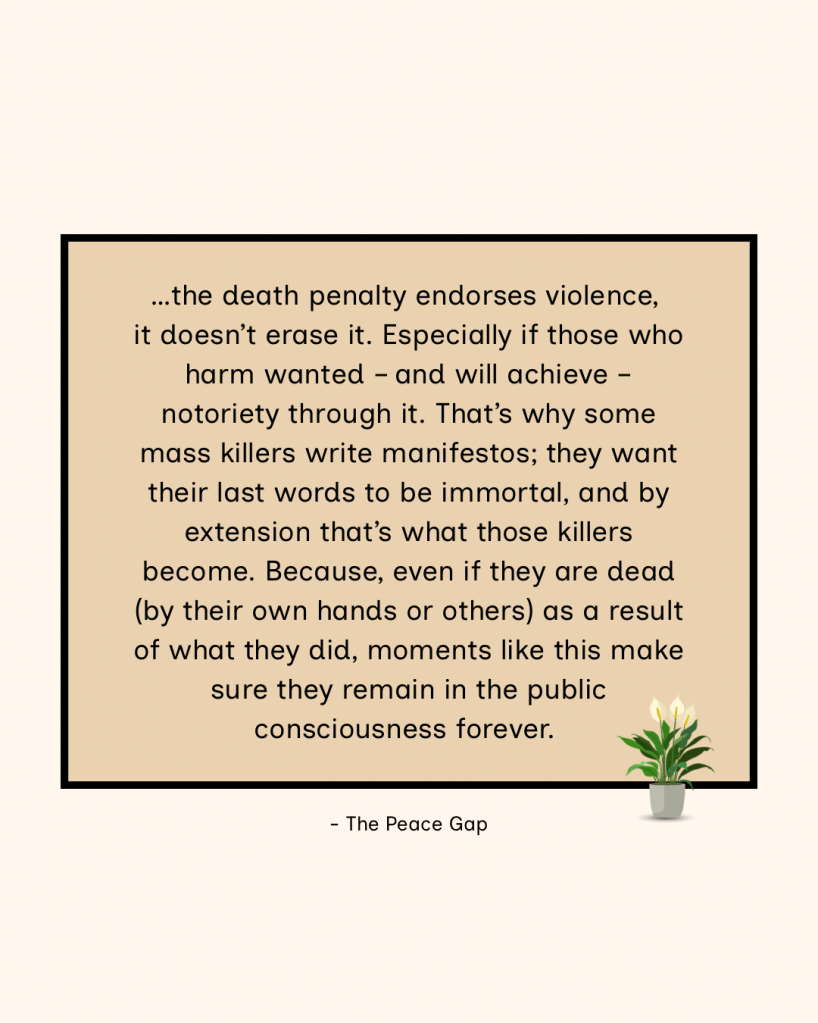
But the death penalty endorses violence, it doesn’t erase it. Especially if those who harm wanted – and will achieve – notoriety through it. That’s why some mass kiIIers write manifestos; they want their last words to be immortal, and by extension that’s what those kiIIers become. Because, even if they are dead (by their own hands or others) as a result of what they did, moments like this make sure they remain in the public consciousness forever.
We cannot address a problem with the same tactic used to create it; history shows us that violence just breeds more violence. So the death penalty cannot be working as a deterrent; if it was hate and harm would have stopped.
If recent cases have taught us anything though, the death penalty lionises the harm doer.
That’s not justice, especially if it doesn’t stop others doing the same, or achieve peace for everyone. (A system, whether it cites violence as “protection” or not, that leaves communities living in the hum of threat, by not deterring future violence, can be referred to as negative peace.)
If we have to bring it down to cold-hard-cash or reputation, it must also be costly, not least of all because of the PR and media attention cases like this get, every time one happens.
Countries might be viewed as willing perpetrators, not saviours, if decision makers are allowing a problem to continue within society-at-large, rather than resolving what they may claim the death penalty solves. Government’s could be seen as implicitly saying they can make the decision to kiII anyone whenever they choose, while badging it as “a war on crime”. Especially if that government can decide what those crimes may be. War and violence always comes with a price.
Walter Griffin, a conscientious objector during the First World War, said “You cannot overcome evil, with evil”, and he has a point: Society cannot overcome a problem with the same tactic used to create it.
The UN has also made its position on the death penalty very clear.
“The old law of an eye for an eye leaves everyone blind.” – Dr. Martin Luther King, Jr.
We might all be able to do our part, even if only a little and within our means, to work towards a plan for peace.
In any event, accountability is not entertainment, and violence cannot – and will not – solve violence.
A society that thinks violence is the answer to everything is on a slippery slope. Especially if they want to see live executions on their TV sets.
*This is an LGBT+ inclusive website, that writes about male violence, particularly towards women, hence using terms like “his” and “men” in this context. However, it is recognised that anyone can be violent – and on “death row”, and people who feel strongly about voicing concerns for their own causes, if done nonviolently, are encouraged to do so: For more details about this website click here.
© The Peace Gap 2026 – All rights reserved. This is an opinion post. For full terms about accessing this content, click here or to find out more about this website click here


You must be logged in to post a comment.