This is an opinion website and usually discusses violence from the outset.
Whether you care about ending male violence against women, or men/boys’ mental health, have children or grandchildren, or just care about humanity, you might want to have a read of this.
“An army of 70,000 is simply not going to cut the mustard in the sort of war we are going to have to face,” says Gen Sir Richard Shirreff. “So I don’t see how we could generate the military capability needed without some form of call-up.” He says the Norwegian model might be one that helps change the British mindset around war.
“There, every school leaver is registered for conscription… and they go and do a year’s training after which they go on to university and when, later, they are competing for jobs, if they’ve got national service on their CV, they’re seen as the best candidates… That’s the sort of thing we should look at.”
He adds: “The case has to be made honestly by political leaders who must really look the population in the eye and say ‘this has got to be done for us to be secure’.”
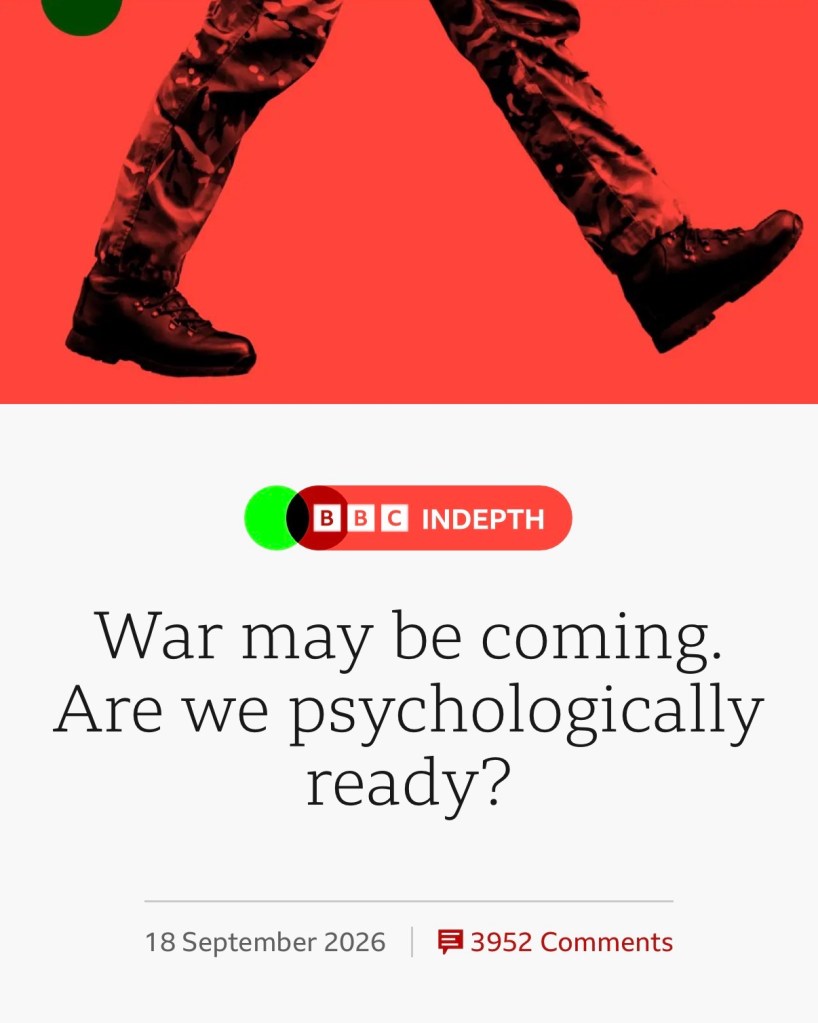
Now, when people talk about security – it’s important to establish whose security they mean? Whose safety? Whose protection?
Because for a long time, it apparently hasn’t been women and children.
Today, many women aren’t safe in their own homes or on the streets, and that’s without war. Male violence is prevalent – including against other men – and women constantly live in the hum of threat; it’s the continuum of violence Cockburn talked about.
Yet, the amount of money spent on male violence prevention is a fraction of what goes on military spending and “justifying” war. We rightly tell boys here they mustn’t kiII – but say it’s ok to kiII a stranger abroad?
We also know that in conflict zones sexual violence increases as well as the care burden, and access to healthcare is restricted especially for pregnant women – according to reports, some of the UK’s maternity services are already in crisis.
So, what happens if we go to war?
Then, who do we think will be sent to these conflict zones? It’s unlikely to be those apparently spoiling for war, more likely your sons and grandsons. Germany have reportedly talked about mandatory conscription for boys, not girls.
So it’s a good question: are you psychologically ready for that? What about supporting those men and boys when they come home traumatised from the horrors of war, then discharged from the military under the care of an already creaking NHS?
That’s before we get to the fact that 4 out of every 10 civilians killed in conflicts were women, and 3 out of 10 were children.
None of this is inevitable by the way.
We know violence is not “human nature”, more about having the capacity to express it ie, it’s a choice. So who is war for? Especially if (like all male violence?), it’s really about greed, status and a false sense of entitlement to “own” something.
Those with the power to start a war, also have the power to prevent it – to achieve positive peace – and, as a society what we permit, we promote.
© The Peace Gap 2026 – All rights reserved. This is an opinion post. For full terms about accessing this content, click here or to find out more about this website click here


You must be logged in to post a comment.