Note to the reader: If you are new here, below is a quick guide on what this website is all about, with some key points further down. As a heads up, content usually contains references to violence from the outset, which some may find disturbing; please read these terms of use if you choose to access this content. If you are affected by the topics discussed on this website, you may also find this list of links of interest.
How does the world move from one of harm to harmony? That’s the peace gap.
The Peace Gap is a website that offers pluralist opinion and a learning space, rooted in feminist theory, for those curious about pacifism, and who want to build or maintain peaceful, collaborative and cohesive communities.
The Peace Gap asks us to show what Cynthia Enloe, a pioneer in the field of international relations, refers to as “feminist curiosity”. This gives us permission to interrogate definitions of “peace”, “safety”, “security”, “protection” and “defence”.
The Peace Gap website examines beliefs, systems and narratives that normalise domination, hate and harm and recognise how violence shows up on a continuum – including in our homes and on our streets, not just in times of military conflict.
It particularly highlights how all of this affects women.
The Peace Gap places emphasis on peace education and global accountability, especially of those “in power”. It brings more than critique; it offers alternatives that hope to make the world a better – and safer – place for all of us.
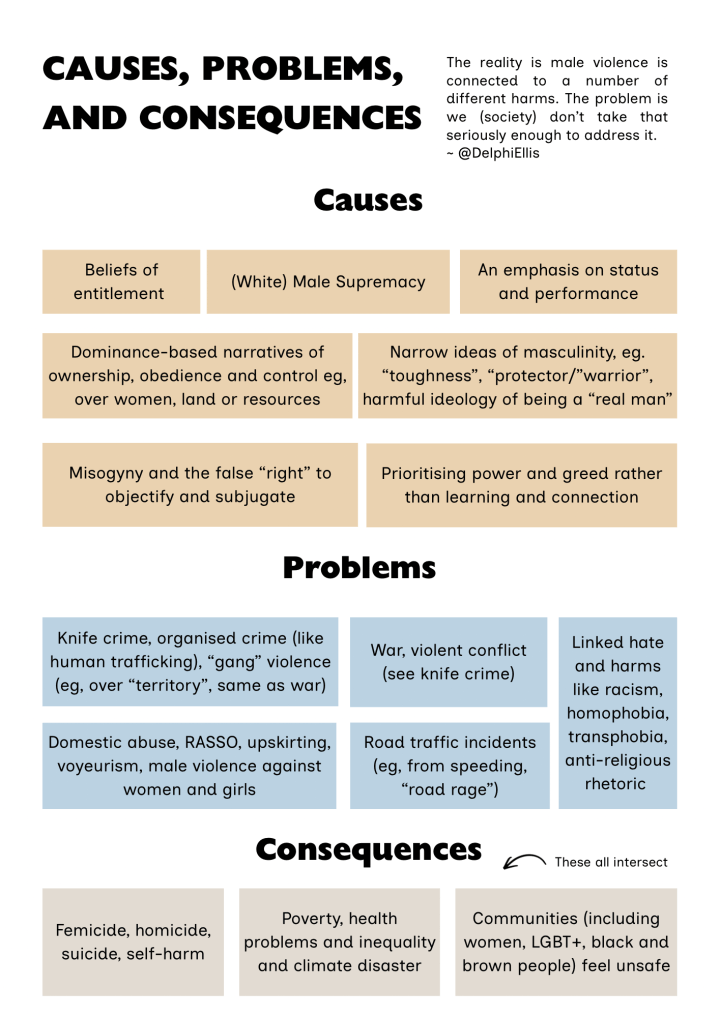
Content is self-funded and approaches pacifism from the perspective that men choose violence*, whether it’s over women or territory, and where it’s motivated by greed, entitlement and the dominance-based ideology of supremacy.
The website is self-published, independently written, custom-designed and free from corporate ownership or institutional backing.*This site recognises that violence can be perpetrated by any gender. However, this is a conversation about male violence and we should be able to have it.
All content is curated by one person (see Who is Behind The Peace Gap? below).
If any of this feels uncomfortable, maybe that discomfort is a reflection point and a portal to inner peace too. Read on for some key points…
Context
On 21st September 2026 – the International Day of Peace – the UK’s security minister, Dan Jarvis, said “The world is a very dangerous place”.
If we let that sink in for a moment, we could demonstrate Enloe’s feminist curiosity and ask questions such as:
- Why is the world still “a very dangerous place”, despite two World Wars and various resolutions that were meant to centre peace?
- Who is predominantly causing that danger? Specifically, what gender are they?
- And, if we are talking about safety, whose safety do we mean?
Because apparently, it’s not women and children.
Data tells us that women are most likely to be killed by a current or ex male partner. Every 10 minutes a woman is intentionally killed, usually by a man she knows.
That’s before we talk about war.
Women face distinct and severe consequences of male violence and violent conflict – which includes displacement, sexual violence, and systemic health crises that are historically under-prioritised. Statistics show that 4 out of every 10 civilians killed in conflicts were women, and 3 out of 10 were children. The latest policy brief from PRIO estimates “756 million women – nearly 19% of the global female population – lived within 50 km of a deadly conflict event…In 2024, approximately 4.4% of the global female population had lived in conflict for more than ten consecutive years”.
We need to talk about this gap, and explore it in terms of:
- a lack of understanding in how this disproportionately affects women
- the absence of meaningful dialogue that connects the dots between male violence, mindset and motivation
- the reality of a world that is actively harming – where ministers openly describe it as a “very dangerous place” yet have the power to stop that, and instead how we can all create one of harmony together.
What if we explored a correlation between the mindset of men who abuse their partners, and the greed and entitlement some men feel gives them the “right” to own something (whether it’s a woman or territory) that might then take us all to war? That’s what this website is about: joining the dots between the harm some men do and how it affects all of us – including men – and working to achieve authentic and long lasting peace.
Peace cannot be kept by force. It can only be achieved by understanding. – Albert Einstein, 14 December 1930 (during a speech to the New History Society.)
Key Points
- Pacifism is a daily practice – it’s not passive; it’s focused on nonviolent, meaningful and proportionate action, and the wellbeing of all humanity. (You can read more about “What is pacifism?” here). Peace also includes inner peace.
- Because of that humanitarian focus, this website is not “party political” – it’s not influenced by a particular strand of politics, except for those that care about people and want a peaceful world for all of us.
- It is a deeply political act, though, to challenge and resist militarist logic and narratives if it positions hierarchy as a veiled form of supremacy, dresses control as “discipline” and promotes the idea that violence is somehow a noble and honourable act. Especially when that leans on hegemonic ideas of masculinity which harm women and children globally – and everyone else.
- On that note, anti-militarism is not anti-military. People who serve their country, whether in the army, air force, navy or police (and others), are often peace keepers.
- That said, they themselves, and again especially women, face significant harm from inside The Job. In the US army for example, it’s reported that a female officer is more likely to be killed by a male colleague than in combat. In the UK army, women – and girls – have also reported being subjected to “brutal abuse, sexual violence and bullying”. None of this is to imply ‘all men” or all military personnel; only to highlight that if discussions of war are focused on safety, that should mean safety for everyone. The cost of war is great, and men are also affected by war, especially in relation to combat deaths, because they predominantly fill military roles – conflict data captures this well. It’s right that we interrogate the ways we think about and organise protection, “defence” and security.
- Finally – lest we forget – the reason many of our fathers and grandfathers went to war, was so that future generations wouldn’t have to. This website respects their service with that reality in mind, by resisting war and violence, as should we all.
The Peace Gap also emphasises that violence is a choice – it is not “natural’ or “in his nature” to hurt people. It asks us to think about how we show up in the world, and whether we are prioritising peace or power. If we want a peaceful world, do each of us show up peacefully every day? If we want to move from a world of harm to harmony, each of us needs to think about how we work to prevent violence.
Who is behind The Peace Gap?
Delphi is a qualified counsellor, trauma-informed educator and women’s peace advocate, who specialises in spiritual health. Her background includes working with the bereaved, including those affected by murder, as well as women subjected to domestic abuse. You can find out more about Delphi here.
Thank you for reading.
Latest posts
- Are we ready to talk about war, yet? If so, when can we talk about peace?
- Negative Peace vs Positive Peace (and what that has to do with all of us)
- Has all that spending made us happy and did it bring us peace?
- Violence is a choice: this is what the scientists said
- Remembrance is an act of resistance – and a call for peace
© The Peace Gap (2026) – All Rights reserved.


You must be logged in to post a comment.