This is an opinion website which usually references violence from the outset.
Johan Galtung, the “father” of peace studies, who discussed the Violence Triangle, also spoke about negative and positive peace.
He suggested that peace which relies on instilling fear, or where citizens remain living in tension, is not true peace. (Dr. Martin Luther King Jr., also referred to that as negative peace.)
In the case of male violence against women (which this website centres), we can see how negative peace might exist within our current Criminal Justice System in the UK, even if with good intentions.
Laws work to prevent the next crime, but without necessarily delivering justice or continued safety. A harm doer may be held to account in one way, but this doesn’t prevent the next violent man harming the next woman, or even stop the one held accountable if his mindset doesn’t change.
Law or “defensive action” that doesn’t deliver stable, lifelong security or tangible safety is not “protection”.
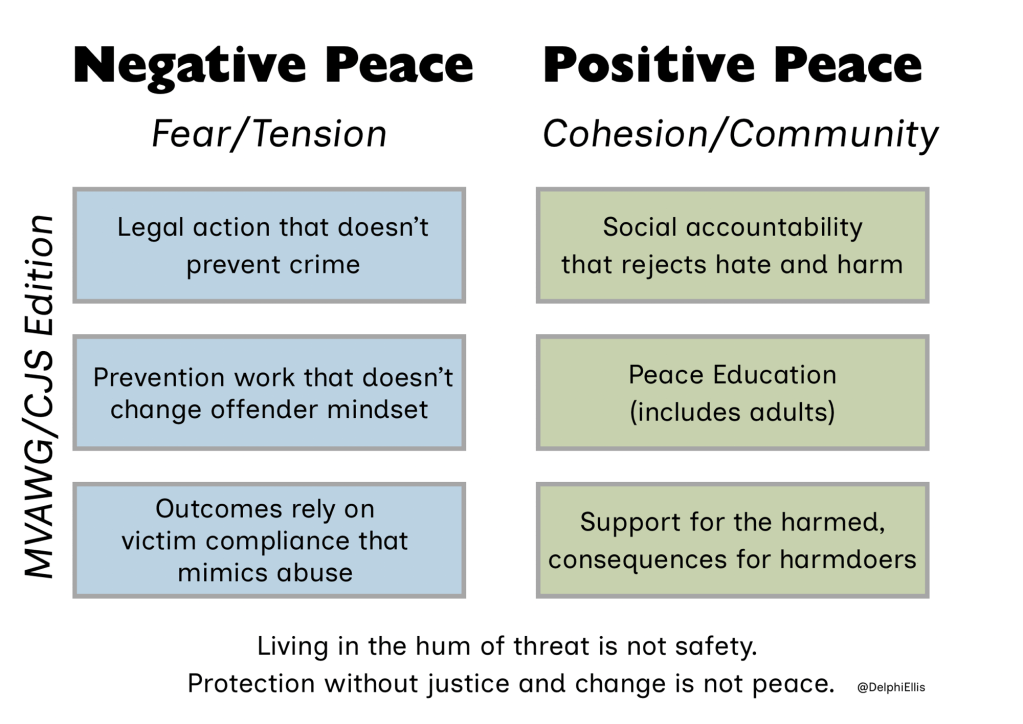
When dealing with male violence from a more holistic, broader approach, positive peace would ask us, as a society, to take a level of social accountability for what we choose to tolerate and what we stand up against. It requires meaningful support for the harmed, alongside consequences for the harm doer – being willing to reject someone from the group, until such behaviours change, rather than excuse them.
Peace is not passive; pacifism is a daily practice.
To what extent do we, as citizens, model nonviolence in our interactions with others, or do we enable, endorse and even uphold narratives and behaviours that allow violent men (in this context) to continue to harm, even when some of that violence is against other men?
When a man engages in displays of misogyny, when he demonstrates a level of entitlement that seeks to objectify, subjugate, oppress or possess women, who (outside of law enforcement) will step in (safely), and steer his behaviour another way? Any one of us can decide to help create a different world.
We can also see how this discussion can extend to negative and positive peace in the context of war.
It requires a significant paradigm shift though, and in particular requires men to do their part to reject – and conscientiously object – to violence and harm. To move from a mindset of entitlement to learning, and behaviours of domination to connection.
It relies on peace education; MLK suggested in his Nobel Lecture in 1964 that “the philosophy and strategy of nonviolence become immediately a subject for study”. It means learning conflict transformation skills, as John Paul Lederach discussed, not just “resolution”, meaningful discussion that not only stops violence today but helps prevents violent conflict in the future.
It means joining the dots between militarism and male violence (Cynthia Cockburn describes this in her continuum) – and the hierarchy of supremacy that seeks to keep others small. Challenging dangerous narratives that imply violence is not only “justified” but “honourable”.
We must learn upstandership, and how to call out the false sense of right to own or inflict harm (whether on land or women), especially when motivated by greed, status and power. It means rejecting the idea that there is only one type of “masculinity” or that violence makes him a “real man”.
We must also interrogate how there is money in war, but there is also a cost. This includes the impact on health services, and the reality of sexual violence in conflict zones, which disproportionately affects women.
An industry that is built entirely around violent conflict, is neither dependable nor sustainable, unless that is there is a continuous push for violence to exist. One that centres wellbeing, peace building and renewable industries could be just as profitable, if that’s what motivates change.
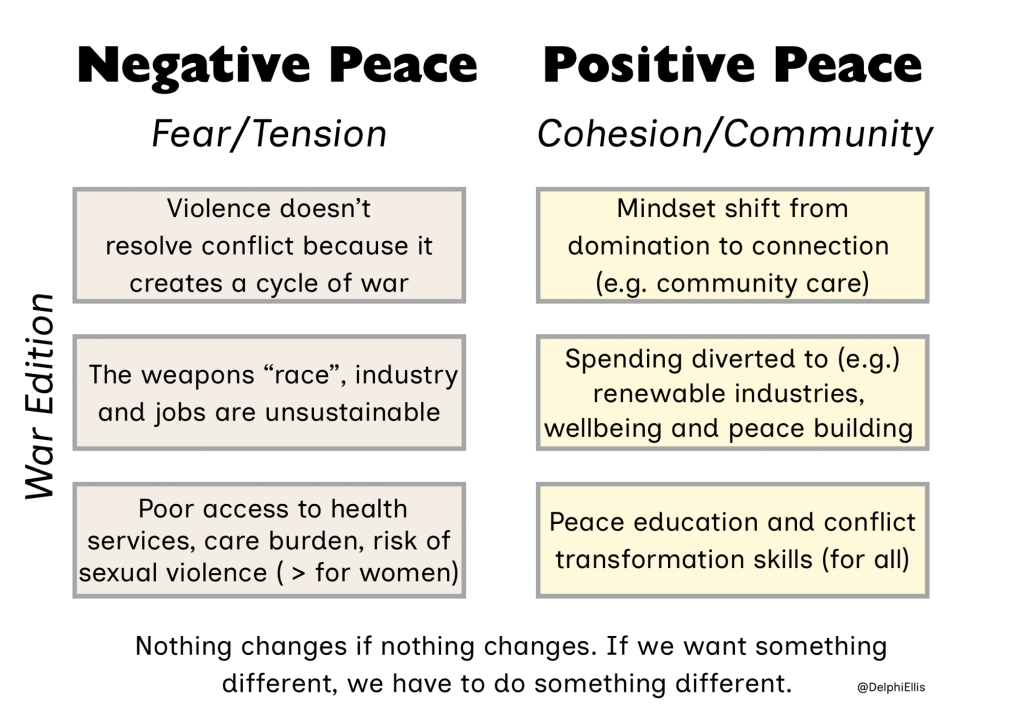
The key point is we now know violence is neither “natural” nor inevitable. So if we want something different we have to do something different.
Nothing changes if nothing changes.
© The Peace Gap 2026 – All rights reserved. This is an opinion post. For full terms about accessing this content, click here or to find out more about this website click here


You must be logged in to post a comment.