This is an opinion website and usually discusses violence from the outset. If you’re affected by topics discussed in this article you may find this list of links of interest.
This is an excerpt and slightly adapted version of a longer article on pacifism available here, where you can also find a discussion on “Alternatives to militarism”.
How is war and hegemonic masculinity connected? Militarism.
Militarism is the belief and value system that perpetuates the myth that war and violence are inevitable. It positions force as a legitimate, effective – and admirable – problem-solving tool.
Militarisation is the mechanism that can make this ideology feel natural to individual men (though not all men), because it recruits their sense of identity and worth into it.
These narrow ideas of what it means to “be a man” are referred to by R.W. Connell as Hegemonic Masculinity. This extends to militarised masculinity, promoting values like obedience (especially to hierarchy), “toughness”, and readiness for violence – whether a country is at war or not.
Militarisation isn’t just about “having an army” – it’s the ideological process by which these military values and ultimately violence are treated as normal, necessary, and even admirable across a whole society (not just within the armed services). It views security through the lens of control and force, and legitimises violence, aggression and domination as a way to maintain order under the banner of entitlement.
Definitions of militarist masculinity, across feminist literature, such as work by Professor Cynthia Enloe, include:
- Violence reframes as protective “duty”, rather than harm
- Emotional suppression is seen as “discipline” and control, (emotional expression seen as “soft”)
- Hierarchy and particularly obedience to is is valorised as strength (this can show up in certain leadership styles/“command and control” management)
- Women and other civilians are positioned as those requiring protection, which reinforces a binary of protector and the protected, that depends on female vulnerability
- The country/nation or “in-group” is an extension of the masculine self, worth defending through force
Incidentally, women can enable militarisation, particularly if she presumes she has to remain silent in a male-dominated environment, because she wants to “get ahead”. Think of a toy company wanting to sell weapons to children, or a video game that wants to show violence towards women – if she wants to be “one of the boys” or doesn’t want to be seen as “soft”, she won’t speak up.
One interesting development is also the work of Roger Stahl. In 2007, he released his first documentary, Militainment Inc.: Militarism and Pop Culture which examines the militarisation process of American pop culture and how war is glamorised in the media and by the entertainment industry.
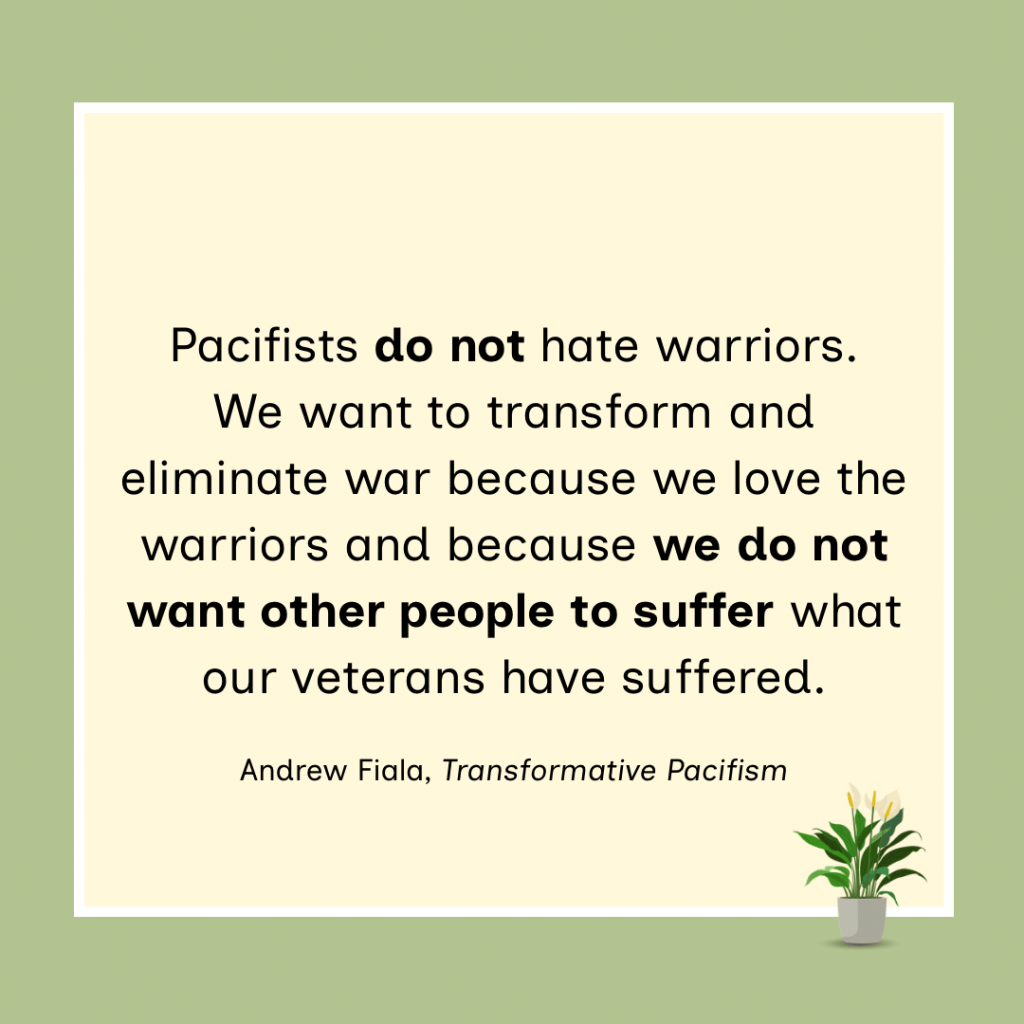
To be clear, anti-militarism is not anti-military. Opposing militarism doesn’t mean that there isn’t a place for defence (of course there is), it just challenges the ideology that violence is the only “reasonable” answer to every problem.
What the literature says
Martin Luther King, Jr famously described militarism as one of the three evils (the other two being racism and excessive (or extreme) materialism).
The King Centre defines militarism as: “war, imperialism, domestic violence, rape, terrorism, human trafficking, media violence, drugs, child abuse, violent crime…”
Notice how this definition encapsulates many different types of violence, whether aimed at a nation and seen as legitimate (like war), or against a woman. Each seem to contain a harmful sense of entitlement to ownership and control, whether it’s gang violence or domestic abuse, which are predominantly perpetrated by men.
Then posit for a moment how society normalises that violence – and becomes desensitised to it – by making excuses for a violent man’s choices (like “he couldn’t help himself”) and thereby enabling or even endorsing it. Remember, militarism sees violence as “natural”.
Then expand that to consider that in a world that fails to prevent domestic abuse and sexual violence – even while condemning it, routinely then searchers for the perpetrator’s justification – “he must have had a good reason”.
This is an example of cultural violence as discussed within Galtung’s Violence Triangle, and amounts to what philosopher Kate Manne refers to as “himpathy”: a script that seeks to legitimise the perpetrator’s behaviour while failing to protect the victim.
The same societal reflex that searches for a perpetrator’s justification at home could make it easier to influence a population when a state claims there is a “just cause” for war.
This does not mean to suggest that domestic abuse causes war; it’s that both draw on the same cultural machinery of excuse-seeking on behalf of those already granted the entitlement and power to use force. This might make it more “palatable” to a population that is being sold an invasion as “reluctant self-defence”, where a war of choice is badged as a war of necessity.
The framing of violence as “natural” – even though research shows that capacity for violence is not compulsion – turns human outrage into societal apathy.
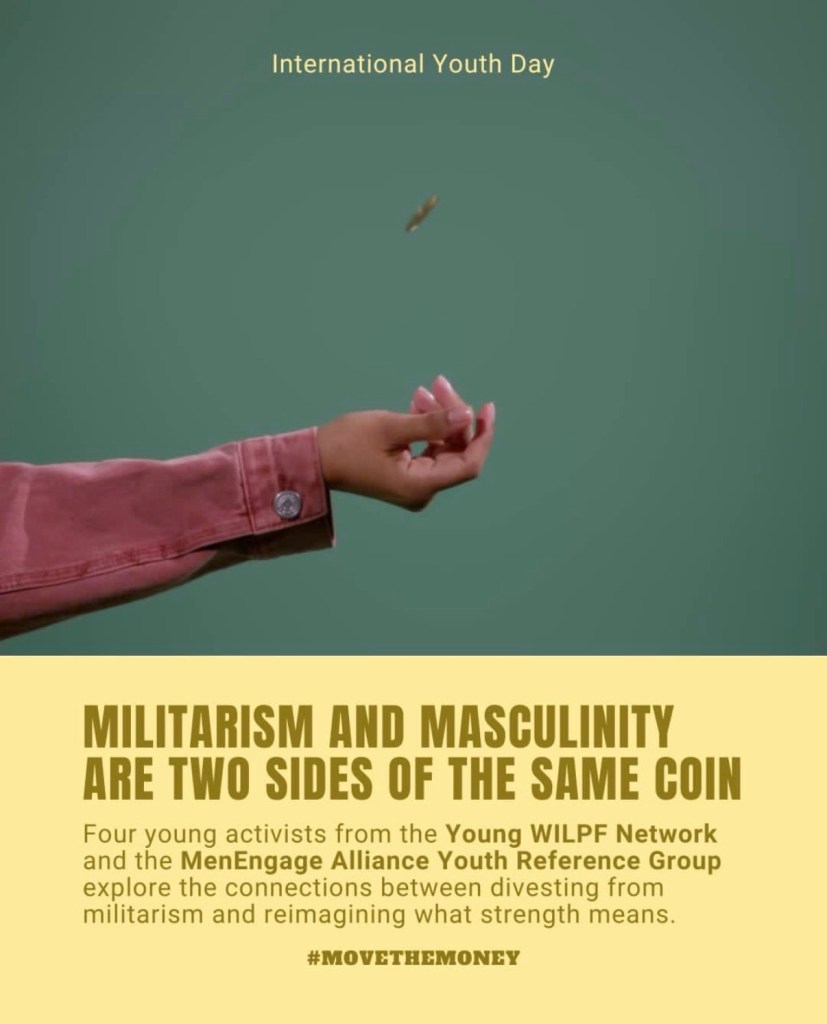
As long as the answer is domination, budgets will keep moving toward weapons instead of classrooms — and boys will keep being offered militarism as the clearest route to dignity anyone’s handed them. Silvia, Chirine, Lasana and Anass aren’t asking for one or the other. They’re asking for both at once, because they’ve watched what happens when only one moves: the money shifts and the norm holds, or the norm shifts and no one funds it. – Read more on the WILPF website.
What about extremism?
Taking this concept a step further, we can explore if militarism may influence men who find themselves embedded in extreme ideology, or radicalised into harmful spaces like the man0sphere.
To understand radicalisation and its causes, researchers will often cite of the 3Ns – need, network and narrative.
For example, some suggest that loneliness and the search for belonging is why some men need to belong in a network and so it’s “natural” they’d fall into a swamp of hate online. However, the narrative, often seems overlooked.
If it was just that men and boys are lonely and need a space to collaborate and find meaning, they’d find a network like a five-a-side or book club, that meets their narrative (or love) of sport or reading – and some do. But for others, they may need a network with a different narrative – one that loves men but hates women.
With this in mind, it is possible that those who align with militarist masculinity as an ideology, for example (even if they don’t know it’s that), may seek out others who share the discourse that prioritises domination and control rather than learning or connection. They may be drawn to other men – especially so-called “manfluencers” – who tell them “You are the real victim here (usually of feminism) and I can help you get your power back” – for a fee, of course.
Militarist logic doesn’t end there though. It can shape media, culture and politics, especially in circles where violence is viewed as “just how it is and how it has to be”.
It can also affect the economy where jobs are tied only to the prospect of war, which becomes mutually reinforcing: job security is reliant on conflict, and vice versa. (See section on Alternatives to Militarism in a longer read here.).
In summary
There are different cited “causes” for war which centre harmful ideology like who has control of something – whether it’s people, territory or resources, like fuel. (Cited causes may also include other threads like security-seeking and nationalism).
It’s worth noting, then, that male violence tends to centre greed, entitlement and ownership of something, whether it’s over women, territory or materials (like drugs).
A significant, under-examined discussion is how “gang violence” and domestic abuse are predominantly perpetrated by men, and may have a similar, harmful ideology. While some suggest there may be other influencing factors (poverty is often cited, even though wealthy men commit domestic abuse), this violence could be understood through the militarist lens of domination, power and control. In this paradigm, one can reasonably conclude that women will never be safe, and eventually perhaps neither will anyone else.
“A true revolution of values will lay hands on the world order and say of war – ‘This way of settling differences is not just.’ This way of burning human beings with napalm, of filling our nation’s homes with orphans and widows, of injecting poisonous drugs of hate into the veins of peoples normally humane, of sending men home from dark and bloody battlefields physically handicapped psychologically deranged, cannot be reconciled with wisdom, justice and love. A nation that continues year after year to spend more money on military defense than on programs of social uplift is approaching spiritual death.”
Source: “Where Do We Go From Here: Chaos or Community?” by Dr. Martin Luther King, Jr.; Boston: Beacon Press, 1967. Taken from The King Centre website
War and violence are not inevitable. If we normalise peace, instead of war and reject the mindset of domination and entitlement, we could make the world a better place for all of us.
© The Peace Gap 2026 – All rights reserved. This is an opinion post which may have appeared on other, affiliated websites. For full terms about accessing this content, click here or to find out more about this website click here.


You must be logged in to post a comment.